
UK Visa Application Process 2026: Avoid Costly Mistakes & Get Approved Faster
Have you plan for the UK Visa Application Process but you don’t know how to apply, Different bien categories, online formulari, document requirements, fees, biometric appointments and waiting periods. The thought of even a small mistake delaying your application, or even leading to a refusal is hard to shake.
The bright side is you know just how the UK visa application process works. Once you get through the stages, it really is not as hard to figure out. The procedure is similar for the majority of visa applications including work, student, family or visitor visas.
Everything that first time applicants need to know is explained in the following guide. It teaches you how to select the right category of visa, collate your supporting documents, fill out the online application, take biometics and track your application while it’s being processed till a decision is reached. By the time you finish, you’ll have a definitive roadmap of the entire UK visa application process and how to avoid all those common mistakes that delay application processing.
How the UK Visa Application Process works
Before starting it is pertinent to understand that UK gives multiple visa categories designed for various objectives.
The visa you choose affects:
- Eligibility requirements
- Supporting documents
- Processing times
- Application fees
- Length of stay
In general, you can place the majority of your applicants into one of four buckets:
Work Visas
These are the visas for individuals who have a job offer from a UK employer.
Common examples include:
- Skilled Worker Visa
- Health and Care Worker Visa
- Global Talent Visa
Study Visas
They typically apply for: Students with offers from approved educational establishments
- Student Visa
- Child Student Visa
Family Visas
Family visas enable eligible individuals to reunite with family members already residing in the UK.
Examples include:
- Spouse Visa
- Partner Visa
- Parent Visa
- Child Visa
Visitor Visas
Visitor visas are for temporary entry, including:
- Tourism
- Business visits
- Medical treatment
- Family visits
The correct category selected is the basis of a successful application.
Heading here… UK Visa requirements – What you need to have Ready before applying
The biggest mistake first-time applicants make is starting the application without having all the information they need.
Most visa categories require:
A Valid Passport
Your passport needs to be valid and with white pages where a possible visa endorsement would go.
Proof of Purpose
You will have to prove purpose of your visit the UK.
Examples include:
- Employment contract
- University acceptance letter
- Marriage certificate
- Invitation letter
Financial Evidence
Most applicants have to show they can finance their stay.
This may include:
- Bank statements
- Salary records
- Sponsorship letters
- Scholarship documentation
English Language Evidence
Some work and study visas also require you to prove your English language ability.
Accommodation Details
Certain applicants need to demonstrate where they will stay while either visiting or relocating.
Having these documents ready in advance will save you a lot of time later on.
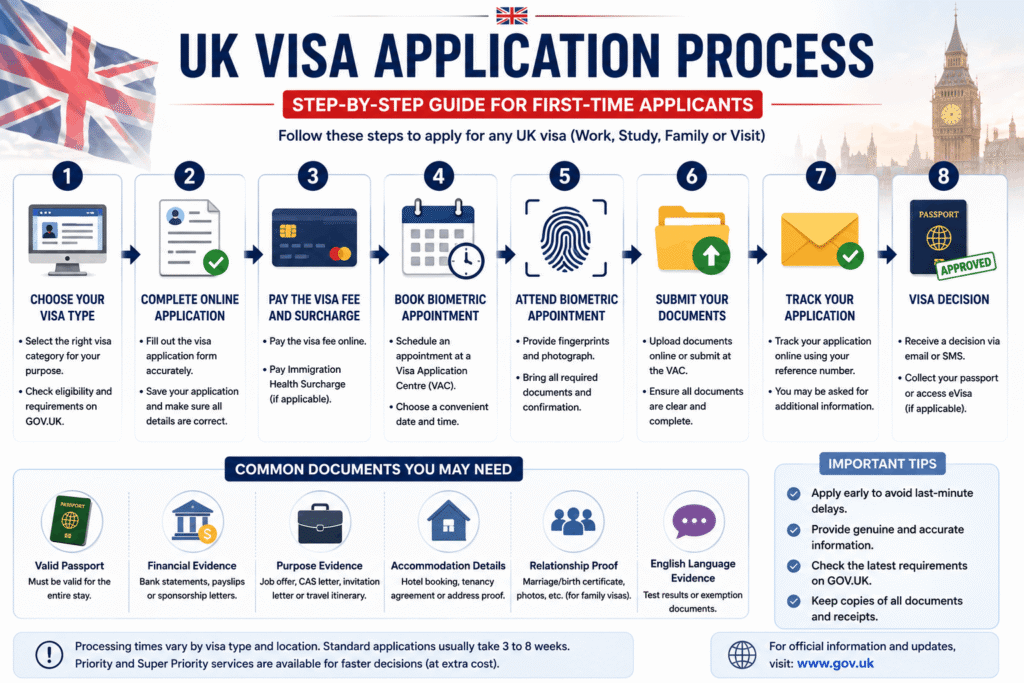
Step-by-Step Guide to apply for a UK visa.
The process of applying for UK visas today is largely online.
So, let’s dissect it line by line.
Step # 1 Select the Right Visa You Do Not Want to Miss
Begin on the official website of government in UK.
UK Home Office provides detailed description about every type of visa.
Picking the unwanted sort could cause delays or rejection too.
Step 2: Build An Online Application
The majority of applicants fill out the UK visa online form through a government gateway.
You’ll provide information such as:
- Personal details
- Travel history
- Employment history
- Family information
- Purpose of travel
Answer every question honestly.
Providing inconsistent data probably is the most common reason applications go under increased scrutiny.
Step 3: Pay the Visa Fee
Once the application is completed, you will generally be requested to remit the appropriate fee.
The amount depends on:
- Visa category
- Duration of stay
- Processing option selected
They will talk a bit more about the fees later.
Step 4: Schedule a Biometrics appointment
The biometric appointment must be attended by most applicants.
During this appointment, officials collect:
- Fingerprints
- Photograph
- Identity verification data
This serves to further assist the UK entry clearance process.
Step 5: Upload Supplementary Documents
Most of the visa application centers are also now accepting digital documents to be uploaded instead.
Typical documents include:
- Passport
- Financial evidence
- Educational records
- Employment documents
- Relationship evidence
Because organized docs tend to be easy to review.
The preparation phase mainly consists of awaiting the scheduled date and month for the appointment.
Carry all necessary papers and ID.
Arrive early.
While the majority of visits are uncomplicated and quick.
Step 7: Awaiting Decision
This is usually the toughest part.
However, after you apply there is often little that you can do other than keep an eye out for updates.
Guidelines and tips for completing an Online Visa Application UK
You have a new simplified application process, and even your online system helps to fast track the work.
Still, mistakes happen.
Double-Check Every Detail
Review:
- Names
- Dates of birth
- Passport numbers
- Travel dates
Even the smallest mistakes can cause issues down the line.
Save Copies of Everything
Save paper and digital copies of:
- Application forms
- Receipts
- Supporting documents
Your self in a few days will thank you if any questions come up.
Use Consistent Information
The information in your application must be consistent with the supporting documents submitted.
The majority of candidates dont even bother with this step.
If dates or employment information don’t add up, more questions ensue.
Types of UK visas and types of documentation required
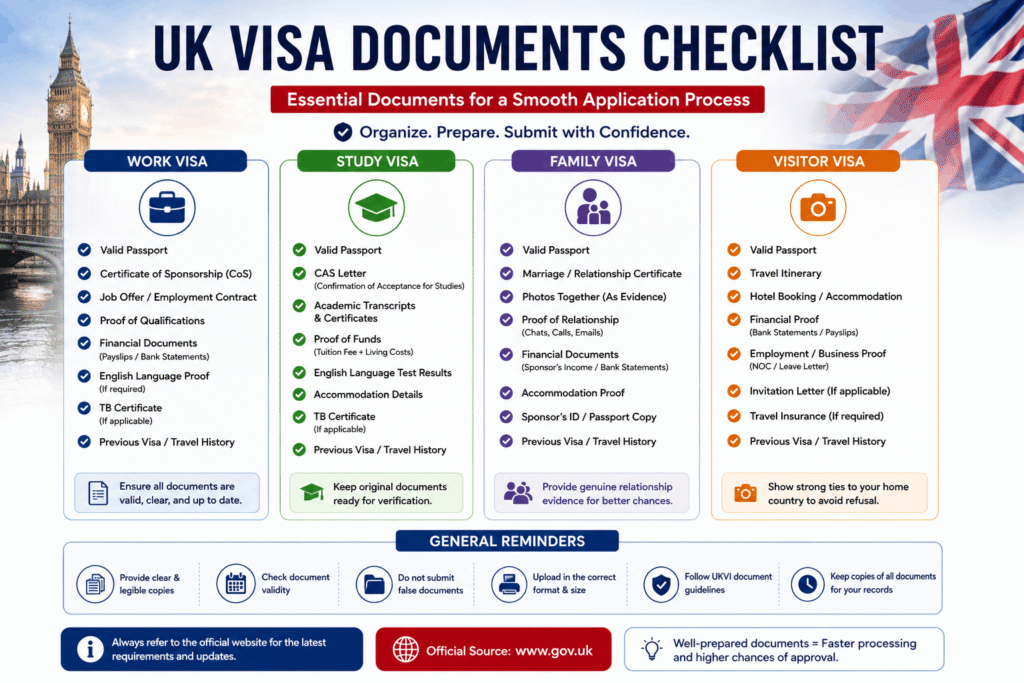
Though the requirements differ from one case to another, a few documents come up across various categories.
Work Visa Documents
Applicants may need:
- Certificate of Sponsorship
- Employment contract
- Salary information
- English language evidence
Student Visa Documents
Students commonly provide:
- Confirmation of Acceptance for Studies (CAS)
- Academic records
- Financial evidence
- English language results
Family Visa Documents
Family visa applicants often submit:
- Marriage certificates
- Birth certificates
- Proof of relationship
- Financial documents
Visitor Visa Documents
Visitors frequently provide:
- Travel itinerary
- Accommodation details
- Bank statements
- Employment confirmation
Always read current guidance prior to submission.
Requirements can change.
UK Visa Fees and Timeline
Having a better understanding of costs, timelines assists applicants to plan more realistically.
Typical UK Visa Fees
Visa type wise fee structure.
Examples include:
- Visitor Visa fees
- Skilled Worker Visa fees
- Student Visa fees
- Family Visa fees
Additional charges may apply for:
- Priority processing
- Super Priority services
- Document scanning assistance
Immigration Health Surcharge
Those on long-term visas are required to pay the Immigration Health Surcharge.
This gives them access to some NHS services while they are here.
Processing Times
According to GOV.UK most standard visitor visa applications are processed within a few weeks, but local processing times will vary – this means that actual timelines depend on location and workload.
Common processing periods include:
- Visitor visas: several weeks
- Student visas: several weeks
- Skilled Worker visas = several weeks
- Family visas: often longer
Priority services can shorten the amount of time that you need to wait.
How the UK Makes a Decision on Your Visa
Your application goes into review once submitted.
This part of the application for UK visa often makes one most anxious.
Officials review:
- Eligibility
- Supporting evidence
- Immigration history
- Financial information
- Security checks
Requests for More Information Some applicants get requests for more information.
That does not inherently point to an issue.
It just means that a clarification is required.
Possible Outcomes
Applicants may receive:
- Approval
- Refusal
- Request for additional evidence
Details for travelling/collection will follow if approved
Biometric Residence Permit and Digital Immigration Status
Most successful applicants are granted proof of their immigration status post arrival.
This has typically been a Biometric Residence Permit, otherwise known as a BRP.
The UK government is moving increasingly towards digital immigration status systems.
This will depend on the type of visa you have applied for, and some other information related to submitting your application:
- Digital status
- Physical documentation
- Both
Always follow the instruction that came with your approval notice.
Common Mistakes to Avoid
In cases the refusal could have been avoided with proper preparation.
Submitting Incomplete Documents
One common problem is the lack of evidence.
Providing Inaccurate Information
Even accidental errors can get red flags raised.
Cutting It Close
There are often penalties for applying too close to your travel date.
Ignoring Financial Requirements
However, many applicants will be surprised just how deeply finance is scrutinised.
Using Unofficial Advice
Immigration forums can be helpful.
Official guidance must always come first.
Things First-Time Applicants Forget
After helping people understand visa systems, I have noticed something.
The majority of applicants worry for hours about the interview/decision
However, the true trouble typically starts even earlier.
Some of the strongest applications are ones that seem like the simplest to create.
They’re the most organized.
More than the applicants would think, a clear doc set and consistent information as well as good preparation often weigh more.
And that’s good news.
And organisation is an ease which you can hold,
Keys to Getting Approved
No one can guarantee approval.
But you can make your application stronger.
Follow Official Guidance
Dial up GOV.UK as your first port of call.
Submit Complete Documentation
Provide exactly what is requested.
Be Honest
Never attempt to hide information.
Apply Early
Explore for potential roadblocks and allow sufficient time to cover any eventualities.
Keep Records
3) Make copies of everything you send in and all communication.
It’s those small little habits that usually go a long way.
FAQ
UK visa application processing time
The processing time differs by the visa category, nation of application and whether priority services are used.
How to Apply for UK Visa Without Job Offer?
Yes. Numerous visa types, like visitor and student visas do not even need employment offers.
What are the documents required for a UK visa application?
Requirements vary based on the type of visa, but generally include a passport, proof of funds and documentation validating the nature of travel.
Can I track UK visa application?
For most of the cases the applicants are notified via application system or visa application center.
What should I do if my UK visa has been refused?
Usually, those who are refused are provided an outline of the rationale behind such refusals as well as next steps to take.
Final Thoughts
The UK visa application system may seem complex at first. However, it is only presented as a complicated procedure; once you break everything up, the process becomes more manageable when taken in individual steps. You should emphasis on selecting the right visa category, providing correct documentation, filling out the online application properly and following their instructions as prescribed.
Preparation is your biggest advantage when applying, be it for a work visa, study visa, family visa or Visitor Visa. Slow down, stay organized and choose your resources responsibly. The more prepared you are, the greater your chances of success.
Always check the official GOV.UK site for the latest requirements and news before applying.