
F1 Student Visa Guide 2026: Rules, Requirements
F1 Student Visa- A guide (2026): Rules, requirements & timeline
Studying in the United States remains a dream for thousands of students around the world. International students flock to the United States for world-renowned education, research and lucrative career options here. Now, before you can actually go to a college or university in the U.S., you must get your head around the F1 student visa process first.
Start with simple Questions Why is F1 visa How long does it take to approve the f1 visa What are the documents required for f1 visa What are new In 2026 related f1 visa
At first glance, it can seemed a bit complicated. With university admissions, SEVIS fees, visa interviews and travel plans all on the near horizon, it is only too easy to feel overwhelmed. The good news is that thousands of students successfully acquire a US F1 visa each year, by taking the right steps and preparing properly.
It covers everything about the F1 visa including eligibility, F1 visa photo specifications, document preparation for your interview, processing time post-visa acceptance and how the F1 schedule impacts your student status after arriving in the USA.
What Is F1 Visa?
Leading of the searched questions around the globe is: what is F1 visa?
F1 are non-immigrant student visas granted to dependents of F2, who may come to the United States temporarily for academic studies at approved educational institutions.
Students usually access with an F1 visa to:
- Universities
- Colleges
- High schools
- Language training programs
- Conservatories
- Academic institutions approved by SEVP
F1 Visa is an educational purpose visa. The visa holder must genuinely intend to study full-time, as opposed to other type of visas(where it could be someone else who sponsors the candidate for an Employment based visa)
The US F1 visa is still the most frequent visa type among students abroad studying and obtaining a degree in the United States.
Who Can Apply for US F1 Visa?
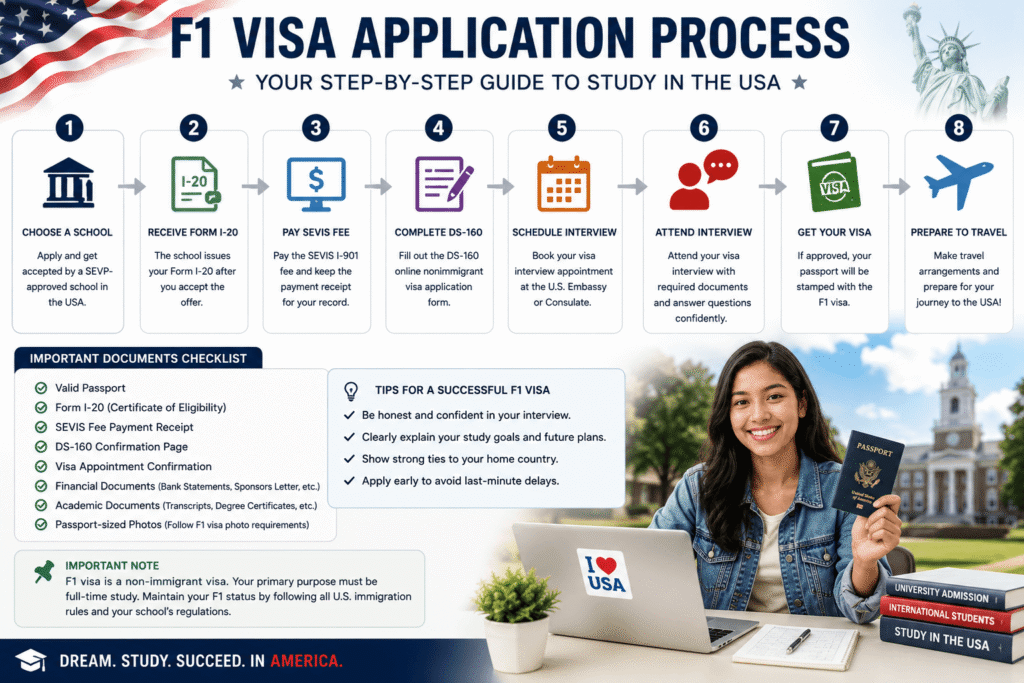
Eligibility Criteria: You should satisfy numerous eligibility criteria prior to applying.
To apply for a US F1 Visa, you need
- Acceptance into a SEVP-approved school
- Form I-20 from the institution
- Proof of financial support
- You must be planning to go back to your home country after completing your studies
- Valid passport
- Completed visa application
The U.S. government wants to ensure that students can sustain living financially, and they have genuine goals of study.
A frequent mistake is focusing merely on admission needs, and overlooking visa eligibility requirements.
Both matter equally.
Step-By-Step Procedure for Applying For an F1 Visa
It all becomes easier once we really understand the approach.
Step 1: Receive Admission
You must get accepted by a U.S. school that is approved by the Student and Exchange Visitor Program (SEVP) before you can apply for an F1 visa.
Upon approval of your application Form I-20 is issued by the institution.
Step 2: Pay the SEVIS Fee
SEVIS stands for the Student and Exchange Visitor Information System.
Applicants must pay the mandated SEVIS fee prior to the appointment of their visa interviews.
Step 3: Complete Form DS-160
DS-160 (Online Non-Immigrant Visa Application)
Visa officers look at this info during the interview so it is very important that this information is correct!
Step Four: Schedule Your Visa Interview
All applicants must almost always attend a visa interview at a U.S. embassy or consulate if they are between 14 and 79 years of age.
Interview wait times per country
Step 5: Attend the Interview
Thus, the visa is decided based on interview.
Preparation matters.
Most candidates successful in making a request spend more time preparing for the interview than completing documentation.
F1 Visa Photograph Requirements You Should Abide By
F1 visa photo requirements are one of the most neglected areas regarding the application process.
A surprising number of applications don’t progress because the applicant has sent incorrect photos.
F1 visa photo requirements as of now usually include:
- Color photograph
- White background
- Recent passport photograph taken within 6 months
- Neutral facial expression
- No glasses (unless medically necessary)
- Full face visible
- Correct dimensions as required for the U.S. visa
Your picture should be a current one.
Even those little peeves may set off a demand for a new photograph.
Make sure you check the specifications of U.S. Department of State before submitting your application
New F1 Visa Rules in 2026
Immigration rules can change quickly, and Students search for New F1 visa Rules frequently.
Although core F1 visa regulations have been relatively unchanged, students should always check for official updates from:
- U.S. Department of State
- USCIS
- SEVP
Areas Students Should Monitor
Employment Rules
Revisions in states on working authorization.
Students should understand:
- On-campus employment
- CPT (Curricular Practical Training)
- OPT (Optional Practical Training)
SEVIS Reporting Requirements
Students must maintain accurate records.
Changes involving:
- Address updates
- Enrollment status
- Program changes
must often be reported.
Visa Interview Procedures
Consular processing procedures are also updated from time to time based on policy and staff levels at each location.
For the new F1 visa rules, always refer to official government sources instead of depending on social media posts/reels.
Understanding the F1 Schedule Requirements
For international students, one of the major responsibilities is that you have to keep an active F1 schedule.
So even when students manage the visa part, they often do not realize that this is just a small part of the puzzle.
What Is an F1 Schedule?
The F1 schedule means you stay enrolled full-time at your school.
Students have to stay in enrolled in:
- Full-time coursework
- Approved academic programs
- Required credit hours
This may make deportation proceedings to be initiated against the student.
Why the F1 Schedule Matters
Your immigration status is contingent on maintaining compliance.
This is the first F1 schedule => If you do not follow your approved F1 schedule it may lead to:
- SEVIS termination
- Status violations
- Future visa complications
Check always with your Designated School Official (DSO) before altering enrollment.
The F1В Visa Processing Time What is administered to you on the courses system as processing _WAIT времени для того, чтобы получить сторону – это зависит от фактора.
Processing times vary.
Several factors influence approval speed:
- Country of application
- Embassy workload
- Administrative processing
- Seasonal demand
Typical Timeline
University Admission
1–6 months
Form I-20 Issuance
1–4 weeks
Visa Interview Scheduling
Several days to several months
Visa Processing
A few days to several weeks
A majority of students started prepping 6 months in advance as per their planned start date.
Starting early reduces stress significantly.
F1 Visa Interview Questions
For many students, the interview is by far the most intimidating stage.
Well, really most interviews are just brief.
Visa officers often focus on:
Academic Plans
Questions may include:
- Why you selected this university
- Why this degree program?
- What are your career goals?
Financial Support
You may be asked:
- What is the source of funding for education?
- How will you cover expenses?
Future Intentions
The officer may ask:
- What are you going to do after graduation?
- Do you intend to return home?
To make sure that your answers are honest and consistent with your application,
Yes, F1 students are permitted to work in the US.
Yes, but restrictions apply.
On-Campus Employment
In general, the majority of student may work on-campus with certain conditions.
Curricular Practical Training (CPT)
CPT gives qualified students an opportunity to engage in work experiences that are related to their field of study.
Optional Practical Training (OPT)
OPT is the temporary employment directly related to an F-1 students area of study.
That means a lot of STEM graduates can be eligible for further extensions.
The most important reason is that you must understand the rules of employment, as unapproved work threatens your immigration status.
However, while there are many acceptance rates from US educational institutions, some F1 visa applications may not go forward.
Typically, most applicants are approved, but the agency does reject some.
Insufficient Financial Evidence
Students must prove sufficient finances.
Weak Academic Purpose
Officers would like to see bona fide educational purposes.
Inconsistent Interview Answers
Contradictions raise concerns.
Failure to Demonstrate Non-Immigrant Intent
Applicants should demonstrate that they plan to leave the U as soon as their studies are over.
If you prepare, your chances of approval will exponentially increase.
Common Mistakes Students Make About the USA F1 Visa
There are lots of students who think that getting admission to a university is the end of their process as they will automatically receive a visa.
It doesn’t.
The admission and visa approval processes are different from each other.
Catch It: Consider getting into university like an invite.
The visa interview is what determines whether or not you will be legally permitted to use that invitation to enter the country.
This distinction is something students who get it prepared for.
Guidelines for Successful F1 Visa Application
Apply Early
Last but not least, do not just wait for the last moment.
Organize Documents
Create a complete application folder.
Understand Your Program
SHARE YOUR ACADEMIC GOALS: → Be prepared to talk about your academic goals
Follow F1 Visa Photo Requirements
Photo mistakes cause unnecessary delays.
Watch New F1 Visa Rules
Indeed, official qualifications may vary over time.
Frequently Asked Questions
WHO NEEDS IT & WHAT IS F1 VISA?
An F1 visa is a non-immigrant student option for full-time international students attending approved U.S. educational institutions.
What is F1 Visa Photo Requirement in 2020
Photo Requirements For F1 Visa Requirement 1- Recent Color Photo Requirement 2- White Background Requirement 3- Full Face Visibility Requirement 4- Follow The Specifications Of U.S.
Who are the new F1 visa rules for 2026?
Updates may include processing procedures changes, employment authorization changes, reporting requirements and interview policy related to F1 visa. Students must be on the lookout for official announcements issued by the government.
Can I work with a US F1 visa?
Yes. Educational institutions offer work options through OCCP, CPT, or OPT programs to students who are eligible, all under immigration policies.
What is an F1 schedule?
A full-time student status (F1 schedule) means that you are maintaining full time enrollment at a school and, thereby, meeting the requirements for your status to remain valid.
Final Thoughts
Basically, it can be divided into 4 essential tasks for a successful USA study journey , figure out what is F1 visa; comply with the F1 visa photo requirements; stay updated to the new F1 visa rules and make sure that you always have an up-to-date F1 schedule.
Although the US F1 visa process may seem daunting initially, students who are well prepared, have their documents organized and set in plan what is required of them usually find themselves at an advantage.
If you’re going to study in the USA 2026, this is enough time to prepare. Planning early allows more time for flexibility, reduces stress and helps ensure a successful visa application experience.