
K-1 Visa Processing Time 2026: Complete Timeline & Expert Guide
K-1 Visa Processing Time 2026: A Full Timeline Guide
When you ask a lawyer a question, of course the answer is going to come with caveats and little ifs, such as, If your partner is something someone else like dying or coming back etc., but generally speaking one burning question has probably kept you up at how long will the k1 visa process take?If yes there could only be So when you are engaged to someone in another country that person is by no means.
The wait can feel endless. You do the paperwork, you check for updates on your case, you join immigration forums, and each day — cancels or no cancels spent peeping in line with bundlers to see how far the processing times have changed. And the answer is unfortunately not always simple.
However, the bright side is that being aware of K-1 visa processing time 2026 can make you set reasonable expectations to prevent pitfalls. Some couples finish less than a year, while for others, it can take well over a year (depending on the country you are applying with, embassy workload and case complexity).
This guide divides each step of the K-1 fiancé(e) visa into sections, provides realistic timeframes during which each step will occur, identifies factors that may encourage or delay approval at your local office, and offers practical techniques that can help keep your case moving forward.
Key Takeaways
K-1 visa processing time in 2026
Expect 10–18 months for most couples from filing to visa issuance.
For example, USCIS petitions generally take ~8–10 months to process.
- National Visa Center (NVC) Processing generally lasts from 2–8 weeks
- Embassy interview scheduling is notably different in every country.
- One of the most common reasons behind delays are;
- Documents missing and Requests for Evidence(RFEs).
- The foreign fiancé(e) must marry within 90 days after entering the U.S.
What Is a K-1 Visa? K-1 Visa Processing Time 2026

The K-1 visa permits a foreign national who is engaged to a U.S. citizen to enter the United States for marriage.
The couple must also marry in the United States within 90 days of entering the country.
If the foreign spouse is married, they may be able to get permanent residency through Adjustment of Status after marriage.
One aspect of the K-1 visa is that generally it can be classified as a nonimmigrant visa, but K-1s are special and almost always go from a direct route to a green card because of their unique nature.
Settled among K-1 visa processing time 2026
A whole range of government agencies are involved in the process.
These include:
- USCIS
- National Visa Center (NVC)
- U.S. Embassy or Consulate
- U.S. Customs and Border Protection | CBP
Each phase gives a little tender loving care to the cycle.
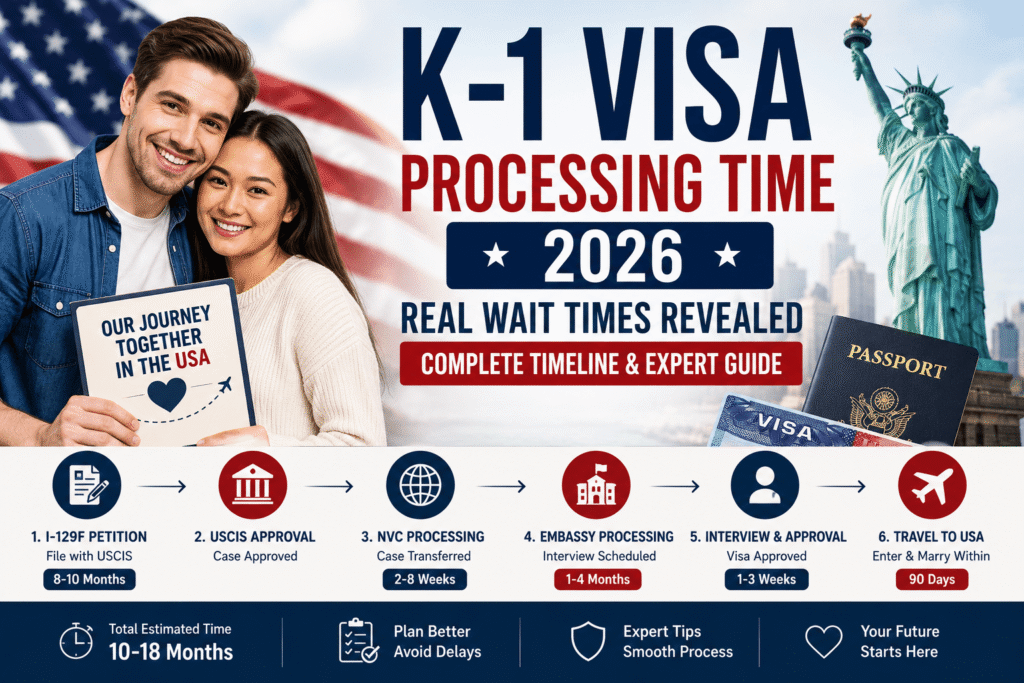
K-1 Visa Time Chart 2026
| Stage | Time Est. |
| Form I-129F Processing | 8–10 Months |
| NVC Processing | 2–8 Weeks |
| Embassy Interview Scheduling | 1–4 Months |
| Visa Issuance | 1–3 Weeks |
| Total Estimated Timeline | 10–18 Months |
Estimates range by location and workload.
Step 1: Filing Form I-129F
All K-1 cases start with Form I-129F, Petition for Alien Fiancé(e).
This is a U.S. citizen petition for which the petitioner provides evidence that:
- U.S. citizenship
- Genuine relationship
- Intent to marry
- Meeting requirement (most of the time)
Common supporting evidence includes:
- Photos together
- Travel records
- Communication history
- A (1) Affidavit from Family and Friends
Current I-129F Processing Time
This is the longest stage for many couples.
Many petitioners receive wait times in 2026 between:
8–10 months
Others move a little faster, but in season slowdown deceleration due to being slammed by an overwhelming employment of work.
What slows this stage down?
Common issues include:
- Missing signatures
- Incomplete forms
- Insufficient relationship evidence
- Incorrect filing fees
- Requests for Evidence (RFEs)
A well-drafted petition can save months.
Step 2: USCIS Approval and Transfer to NVC
After USCIS has decent for the petition, the case is routed over to National Visa Center.
Couples often mistake approval for the end of the process.
But, in fact, there are still a few key steps to go through.
What the NVC Does
The NVC:
- Creates a case number
- Shifts the case to proper embassy
- Conducts preliminary processing
Luckily, though, this phase tends not to be as lasting.
Typical NVC Processing Time
If you land upon making the tech stack and frameworks upfront, it saves a significant amount of time later.
Requests for Evidence (RFEs)
RFE is issued when USCIS needs more information.
Common reasons include:
- Missing documents
- Weak relationship evidence
- Incomplete forms
- Responding quickly is critical.
- Embassy Backlogs
Certain consulates process cases quicker than others.
A lot depends on local staffing levels and application volume.
Administrative Processing
Occasionally, cases undergo additional review.
Administrative processing can extend by a few weeks or months.
Document Problems
Missing:
- Police certificates
- Birth certificates
- Divorce records
can significantly delay interview scheduling.
K-1 Visa: How to Speed Up the Process
No strategy guarantees faster approval.
On the other hand there are few practices that minimize unavoidable delays.
Submit a Complete Petition
Double-check:
- Signatures
- Dates
- Supporting evidence
before filing.
Organize Relationship Evidence
Well documented history of your previous relationships
Think quality over quantity.
Monitor Case Status Regularly
Stay updated through USCIS as well as embassy mediums.
Prepare Documents Early
Gather only for embassy guidelines, and do not wait.
- Birth certificates
- Police records
- Financial evidence
Early preparation reduces stress later.
Processing Time For K-1 Visa vs CR-1 Visa
Much of what applicants read about the K-1 visa couples, compare this visa with a CR-1 based spousal visa.
K-1 Visa
Pros:
- May have a quicker time to first entry
Cons:
- An other process of Adjustment of Status
- Additional filing fees
CR-1 Visa
Pros:
- Permanent Resident Status retained at time of entry
- Fewer post-arrival filings
Cons:
- Must marry first
- Often longer upfront process
Depending on what is important to you; one option is better.
Next Steps After the K-1 Visa is Approved
Approval isn’t the final step.
After entering the United States:
Marry within ninety days
By law marriage must happen within 90 days of arrival.
Not marrying results in serious immigration problems.
File for Adjustment of Status
Normally the foreign spouse files after marriage:
- Form I-485
- Employment authorization request
- Advance parole request
Green Card Processing
Adjustment of Status often adds:
- 8–18 additional months
before permanent residency approval.
No. 1 Key Insight Couples Overlook
Most articles online only address the processing at USCIS.
However, moving through USCIS is not the only milestone on this timeline.
By 2026, delays in scheduling at embassies were a very real top worst-case scenario example for many couples alongside petition approval times.
That means two couples with exactly the same USCIS approval date can be given interviews months apart based on geography.
Do not just a time frame based on USCIS processing times
Do some homework on the work load of your specific embassies, also.
That’s usually a more realistic expectation.
Total Estimated K-1 Visa Timeline From Start to Finish in 2026
Best-Case Scenario
- USCIS: 6–8 months
- NVC: 2–4 weeks
- Embassy: 1 month
Total:
8–12 months
Average Scenario
- USCIS: 8–10 months
- NVC: 1 month
- Embassy: 2–4 months
Total:
10–18 months
Delayed Case Scenario
- RFEs
- Administrative processing
- Embassy backlogs
Total:
18–24+ months
Recommended Sources for Citation
When publishing this article, cite:
Those are the main official sources on K-1 visa information.
Frequently Asked Questions
The processing duration of a K-1 visa in 2026
How long is the total K-1 visa time line from filing to visa issuance for most couples?
What Is A K-1 Visa?
Recurrent tracks are USCIS back logs, Requests for Evidence (RFE), delays by embassies, Administrative Processing and lack of documents.
Can I expedite a K-1 visa?
There are limited exceptions that allow for expedited processing in the context of humanitarian and/or significant public interest considerations.
Speed of NVC– K-1 vs CR-1 visa
The K-1 is usually faster than the CR-1, as it allows for entry to the USA sooner but does not allow you an immigrant visa right away while a CR-1 gives you immediately once you land.
What happens after my fiance(e) has been admitted to the US?
Now you are required to marry within 90 days of entering the U.S. and apply for Adjustment of Status in order to receive permanent residency.
There were some rumors floating around about whether the location of a given embassy would impact processing for K-1s.
Yes. Embassy Workload: One of the most important variables affecting K-1 Visa Processing Time 2026
Final Thoughts
K-1 visa processing time 2026 still substantially relies on 3 areas; USCIS workload, the scheduling at each embassy around the world, whether you can prepare a strong k-1 case parent. Most couples can plan for roughly 10–18 months, but takes care to prepare as thoroughly as possible to minimize unnecessary delays and the process is more seamless.
The most prudent course of action is to seubmit a complete petition, prepare your documents ahead of time, check on your case regularly, and realize that embassy processing times can matter as part of the same story as USCIS approval timings. If you use some foresight and realistic expectations, you’ll be in a much better place to bring your fiancé(e) to America & start your lives together.