
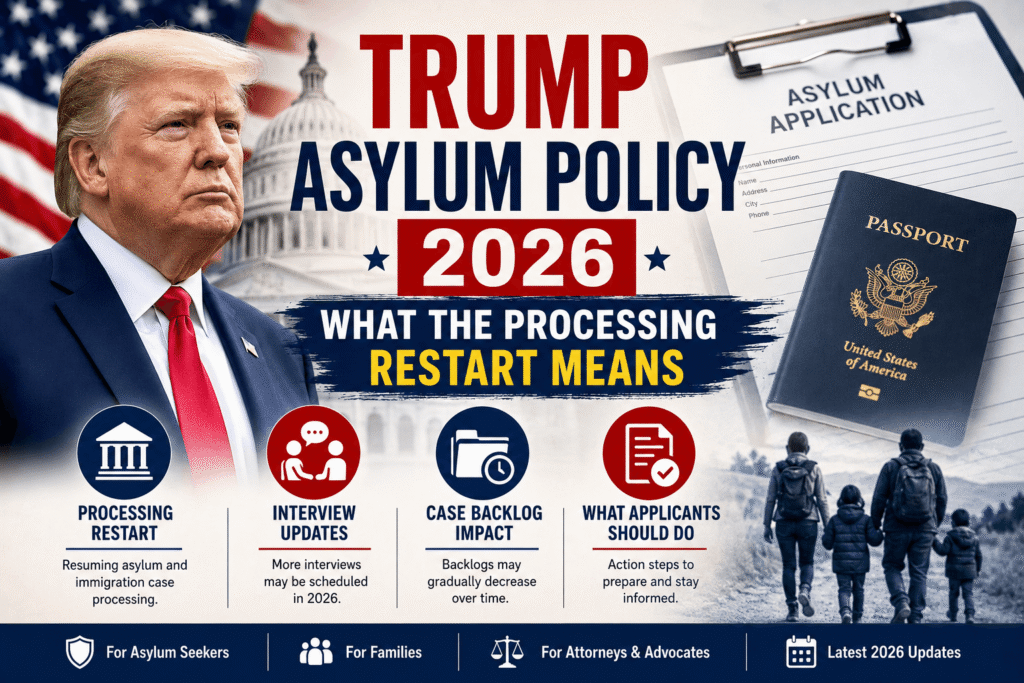
Trump Asylum Policy 2026: What the Processing Restart Means
What the Restart of Processing Means for Trump Asylum Policy 2026
Asylum seekers have lived in limbo for years. Interviews were postponed, backlogs piled up, immigration courts became overwhelmed, and applicants waited months or years for an update on their cases.
But now, a national immigration first has become: the Trump administration says it will resume asylum and immigration processing.
This announcement raises several questions for example, for asylum seekers, humanitarian relief applicants, immigration attorneys and family members waiting for answers.
Are pending asylum applications finally going to get advanced? Will interview wait times improve? Could immigration backlogs shrink? And maybe most crucially, what to do now for applicants?
In fact, such a restart in processing could impact millions of immigration matters throughout the U.S. But knowing what the announcement even means and what it doesn’t mean, is important.
This guide covers a number of the key developments including who will be affected, how asylum processing works, what happens next in 2026, and concrete steps that applicants can take to prepare while awaiting further implementation.
Trump Asylum Policy 2026: What the Processing Restart Means
Key Takeaways
Very Short Answer — What Website You Should Go in This Moment
- The Trump administration is signaling it will restart some asylum and immigration processing functions.
- Individuals with pending asylum applications could start moving through the system more consistently.
- More interview scheduling is expected to happen if more their resources are invested.
- Immigration court backlogs are not going to disappear overnight.
- Your eligibility to work in the U.S. is usually still linked to existing asylum principles.
- There could be indirect benefits for family members of asylum applicants if delays are reduced.
- Processing enhancements will differ broadly by market.
- The most reliable sources include official updates from USCIS, EOIR, and the Department of Homeland Security.
Why We Are in an Asylum Backlog Crisis
In order to see why the announcement should matter, we need to first understand the sheer size of a backlog that already exists.
The United States asylum system had been struggling for years.
Applicants often experience:
- Long interview waits
- Immigration court delays
- Staffing shortages
- Administrative bottlenecks
- Increased filing volumes
However, most asylum seekers have waited years for a ruling.
Others have waited a long time, without even an interview date yet offered.
Some are in removal proceedings or have a hearing pending.
The delays are creating tremendous uncertainty for families that want safety and stability.
This is partly why the processing restart announcement has captured so much attention.
The Fundamental Definition of Processing Restart
The biggest fallacy around this is the sentiment of a processing restart translates to immediate approvals.
It doesn’t.
In all cases, a restart means government agencies may resume or ramp up activities related to:
- Asylum interviews
- Case reviews
- Application adjudications
- Scheduling decisions
- Administrative processing
In a practical sense that could mean cases that have been stalled for sometime will start moving again.
Individual outcomes, however, are still determined by the personal circumstances of the case (eligibility & evidence).
Who Lives in the World of Trump’s Asylum Rule, 2026?
The effect goes beyond asylum seekers alone.
Several groups may be affected.
1. Pending Asylum Applicants
Applicants currently waiting for:
- Affirmative asylum interviews
- USCIS decisions
- Follow-up requests
might get some action on their cases.
2. Immigration Court Applicants
People with cases before immigration judges may see their circumstances shift based on court calendar prioritizations.
3. Humanitarian Relief Applicants
Those seeking:
- Asylum
- Withholding of removal
- Protection under the Convention Against Torture (CAT)
may also be impacted.
4. Family Members
Those with approved asylum applications may also see faster processing, which might indirectly help their family members awaiting immigration benefits through theirs.
5. Immigration Attorneys and Advocates
And lawyers will most probably monitor changes closely to provide legal advice and modify case strategy.
What Is the U.S. Asylum System?
As many of the applicants who hear about policy changes without any knowledge of the actual process that is underlying it.
Let’s simplify it.
Affirmative Asylum
Affirmative asylum is filed directly with USCIS.
Typical steps include:
- Submit Form I-589
- Receive receipt notice
- Complete biometrics
- Attend interview
- Receive decision
When there are scarce resources, this pathway often sits on schedule for a long time.
Defensive Asylum
Defensive asylum happens when a person is in the U.S. already and is facing removal proceedings who asks for protection as a defensive manner.
The process generally involves:
- Immigration court hearings
- Evidence submission
- Judge review
- Final decision
The types of processing improvements could impact each system differently.
The Reasons Do Not Start From 2023: Why This Restart Matters for Pending Asylum Cases
Those awaiting in the system like applicants will probably be lastly impacted probably the most.
Potential Benefits
- More interview scheduling
- Faster case review
- Increased decision issuance
- Reduced administrative delays
What Not To Assume About Applications
The restart does not guarantee:
- Immediate approval
- Expedited processing
- Automatic eligibility
- Elimination of backlog
Each case still needs to be reviewed individually.
This distinction is important.
Could Asylum Interview Wait Times Get Better???
This is one of the most frequent questions candidates ask.
The response, primarily reliant on assets.
Depending on how many officers are diverted to processing asylum, the capacity for interviews could rise.
That may lead to:
- Increase in the number of interviews every month
- Reduced waiting periods
- Improved case movement
But improvements can take years to show up after a long backlog.
Imagine this as opening more checkout lines in a full grocery store.
Lines may start moving but the crowd didn’t just vanish overnight.
Immigration Court Backlogs Effects
Immigration courts have their own problems.
The backlog state has grewn significantly over the time due to:
- Staffing limitations
- Increased case volume
- Procedural delays
While asylum processing may improve, court systems could still be stressed.
Possible Outcomes
Some positive effects could include:
- More efficient scheduling
- Better case management
- Reduced waiting periods
But at this point backlog reduction is a problem that will take time to solve.
Applicants should maintain realistic expectations.
What This Means For Work Authorization
Asylum seekers would rely on employment authorization while they’re waiting for those decisions to come in.
Current Rules Generally Allow
Asylum applicants can apply for work authorization after observing certain waiting period conditions.
This processing restart may indirectly assist in the following manner:
- Improving case movement
- Reducing uncertainty
- Clarifying status timelines
But until such an announcement is made, work permit eligibility will remain subject to existing policy.
Humanitarian Relief Immigration Cases Other Than Asylum
The discussion is frequently limited to dealing with asylum.
However, humanitarian protection includes different tiers.
Withholding of Removal
People can apply for protection if they’re at risk of being persecuted.
Convention Against Torture (CAT)
There are certain protections if you fear torture within your home country.
Other Humanitarian Pathways
Some applicants follow other types of relief based on their individual situation.
Processing advancements could also affect these cases.
What Immigration Attorneys Are Watching Closely
Lawyers aren’t just glancing at headlines.
They are keeping an eye out for implementation fine print.
Key questions include:
- Which cases will be dealt with the highest priority?
- Q: To which offices will resources be allocated?
- Will interview scheduling increase?
- How will backlog management be impacted?
Those questions are often key to whether policy announcements lead to real outcomes.
What Most News Articles Get Wrong
The political ramifications from coverage dominate.
However, what applicants really care about is something far more simple:
When will my case ever progress?
The fact is operational adjustments tend to outweigh the political headlines.
A policy announcement only has no meaning when:
- Interviews are scheduled
- Cases are reviewed
- Decisions are issued
At face value, this sounds like what an applicant should do: focus on actual implementation and not just assumptions.
This pragmatic lens is a common component of news reporting that gets lost in the wider view.
Have you filed for asylum and still waiting a decision? Are you thinking or planning to file but are unsure on how the process? Here are steps now!
In the meantime, there are some things applicants can do while waiting for further updates.
Keep Your Address Updated
Noting that updated contact information might lead to failure of catching notices.
Monitor Case Status
Check official case systems regularly.
Maintain Copies of Documents
Organize:
- Applications
- Receipts
- Evidence
- Correspondence
Consult Qualified Legal Counsel
Applicants can consult professionals to learn how changes impact their specific circumstances.
Prepare for Potential Interviews
Collect up-to-date evidence before a notice comes.
Being prepared reduces stress later.
What Family Members Need to Know
Family members also have the same doubt as applicants.
Common concerns include:
- Reunification delays
- Work authorization questions
- Long-term immigration plans
Some of the family-related benefits could advance more quickly if processing becomes swifter.
However, timelines still reliant on how an individual case plays out.
Challenges Which Are Still There Even After Restart
Managing expectations should be realistic
Several challenges may remain.
Staffing Limitations
More staff could be required.
Large Existing Backlogs
No cases you have taken on over many years can be resolved overnight.
Resource Constraints
Funding and capacity for operation stay elements in regards to.
Regional Differences
Some offices may respond sooner than others.
Experiences are likely to be multi-location dependent.
How Might This Have Impact On More Future Asylum Applicants.
Future applicants may deal with an environment different than that faced by filings a few years ago.
Possible changes include:
- More consistent scheduling
- Improved processing efficiency
- Better communication
But requirements for filing and eligibility standards are important.
Applicants must keep making a strong evidence-based cases.
US Immigration Conditions for 2026
Difference Between Visa and Green Card
I want to take you through the forms that are required for an immigration medical exam and what is needed in order qualify Immigration Medical Exam Requirements
Recommended Authoritative Sources
When publishing this article, cite:
We will revamp USCIS to deliver a 21st-century immigration system.
Executive Office for Immigration Review (EOIR)
DHS | Department of Homeland Security
These agencies give official word on asylum processing and immigration policy implementation.
Continued Watch for Next Months
They will be determined by several indicators that signals if the restart is yielding measurable results.
Increased Interview Notices
One of the earliest signs.
Faster Case Processing
Once October 2023 comes around applicants may start to report movement in pending cases.
Government Staffing Announcements
New hires typically indicate an expansion of operations.
Updated Processing Data
Harder official scepticism on backlogs might find its clearest expression in statistics.
Keeping track of these developments can tell applicants how well those changes translate into real-world improvements.
Frequently Asked Questions
What reboot of Trump asylum policy means for 2026
It broadly means plans to restart, scale up or resume asylum and immigration processing including interviews, case reviews and adjudications.
Will pending asylum applications finally process?
Pending cases are likely to be more active given additional processing resources if such resources become available.
Are asylum interviews wait times going to improve?
Potentially. Improvements are contingent on the number of staff, the available resources and manner in managing backlogs.
Does asylum approval follow the processing restart?
No. Individual review of an asylum application, however, still requires a legal eligibility analysis.
Q: WILL IMMIGRATION COURT BACKLOGS DISAPPEAR?
Not immediately. They take years to develop, and it took more than a year, for these court backlogs to come down.
Can applicants for asylum still apply for work permits?
Under current rules, asylum applicants will largely continue to be able to apply for work authorization.
What can asylum applicants do now?
Update contact information, track the status of each case, ensure accurate recordkeeping, assemble evidence and seek legal counsel if needed
Q3. Impact on family members
If case processing is more efficient, and applications move through the system faster, family members may indirectly benefit.
Final Thoughts
Trump Asylum Policy 2026: What the Processing Restart Means This week announcement is highly talked about because it targets on one issues around U.S. immigration problems: Delays!
The idea of more processing gives hope to asylum seekers, humanitarian relief applicants, immigration attorneys and their families who had seen cases pending for too long. At the same time, applicants need to know they should take a realistic approach. But backlogs, staffing limitations and the complexity of the boards’ caseloads mean great advances may still take time.
The best thing you can do is: be informed through your recognized resources, keep documentation in order, get ready for possible case movement and just focus on the change that is really happening not policy changes but systemic ones to our immigration system. Yet, if headlines matter, posturing matters too but not nearly so much as implementation.