
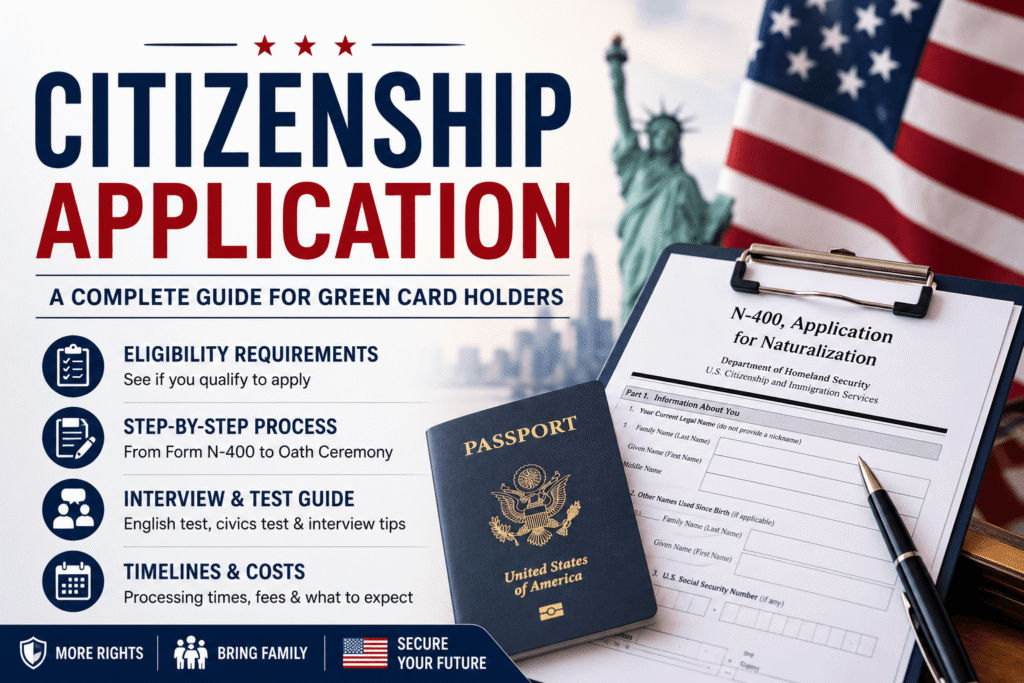
Citizenship Application: A Complete Guide for Green Card Holders
Becoming a U.S. citizen is a goal that many immigrants spend years doing everything they can to reach. For others (in this context), it’s about the privilege of being able to vote. For families it is about safety and finally being at home in the country they have made their own.
As a lawful permanent resident, if you are considering applying for citizenship, you might be asking the same questions thousands of others do each year. Am I eligible? How long does it takes the process? What documents do I need? And what does one, if any mistake should I not make?
The bright side is that the procedure for becoming aU.S. citizen is frequently less complex than you think—if you know what to expect and prepare your self effectively. Every step of the way, this guide explains the process in layman terms so you can move forward with certainty.
5 Common Citizenship Application Mistakes That Cause Delays
A green card provides lots of substantial rights but so does citizenship, and there are privileges to citizenship that do not apply to permanent residency.
Thousands devote years to renewing their green cards, fretting over travel restrictions or wondering how changes in policy might impact their immigrant status. This uncertainty, by and large, is dispelled through citizenship.
As a U.S. citizen, you have:
- The privilege of casting votes on a national level
- Eligibility for certain government jobs
- Protection from deportation (in most instances)
- Access to a U.S. passport
- The maximum number of family members you can sponsor
- No requirement for renewals of a Green Card
- Full participation in civic life
Citizenship means a lot more than just a legal status for many immigrants. It’s a sense of belonging.
Understanding the Citizenship Application Process
The formal procedure for naturalization is how to acquire U.S. citizenship, which in essence signifies citizenship by birthright.
Naturalization enables qualifying lawful permanent residents to become citizens through the U.S. Citizenship and Immigration Services (USCIS).
The process generally involves:
- Determining eligibility
- Completing Form N-400
- Submitting supporting documents
- Attending biometrics
- Completing the citizenship interview
- Take and pass the civics test in English
- Taking the Oath of Allegiance
While this may sound like a long list, the majority of applicants navigate their way through these steps each year.
Who Can Apply for Citizenship?
Prior to beginning your application you need to identify if you qualify.
General Eligibility Requirements
Green card holders may apply if most meet the following criteria:
- Are at least 18 years old
- Applied to apply at least five years before
- Have lived in the United States from this point forward
- Permanently live within the United States for the specified amount of time
- Demonstrate good moral character
- Able to comply with English and civics requirements
- Support The Principles Of All American Civil Rights
The Three-Year Rule
Some applicants qualify earlier.
You can be eligible in three years if:
- You are a spouse of a U.S. citizen
- You have been living continuously with your U.S. citizen spouse
- Before that your spouse keep the citizenship for required period
This exception is often ignored by permanent residents making their wait much longer than it needs to be.
Continuous Residence: Many People Get This Wrong
A very frequently occurring problem in a citizenship application concerns continuous residence
Continuous residence means you have not left your permanent home which is in the United States.
This is why long international trips can cause problems.
Travel and Citizenship Eligibility
Generally:
- Generally, itineraries of less than 6 months aren’t problems
- Two extremes of travel, that is trips longer than a year and those shorter than six months — would presumably be problem-free; but anything between the two may raise eyebrows.
- Longer-than-one-year trips can ruin your eligibility.
Suppose, for example, that you lived outside the U.S. for nine months to care for a sick family member; in that case, USCIS will probably request evidence of your intent to maintain your residence in the United States.
Documents that help include:
- Tax returns
- Employment records
- Mortgage statements
- Utility bills
- Lease agreements
Some applicants are shocked hearing how heavy a role travel history can play in their case.
Physical Presence Requirements
Being physically present is not the same as having been continuously physically present.
USCIS just wants to make sure you actually spent the time in the U.S.
For most applicants:
- You have to be physically in the country for a minimum of 30 months out of the 5 year qualifying period before you apply
Now, for applicants applying under the three-year marriage route:
- For at least 18 months of the qualifying period, you have been physically present.
Keep precise travel documents (critical).
Write Correctly N-400 form
The citizenship application is known formally as the N-400.
The actual form is simple enough, but well-intentioned mistakes can only slow things down.
You’ll need information about:
- Employment history
- Residential history
- Travel history
- Family members
- Immigration records
- Criminal history (if applicable)
A Personal Tip
In the industry, one of the worst mistakes applicants make is to guess dates.
Fact check dates of travel, work or previous residences if you need clarification.
USCIS has a wide network of records at its disposal. Interviewers often ask follow-up questions if the information does not align with what was previously mentioned.
Documents You’ll Need
These documents will vary, depending on your situation.
However, most applicants submit:
- Green card copy
- Government-issued identification
- Passport copies
- Marriage certificates (if applicable)
- Divorce decrees (if applicable)
- Tax records
- Selective Service documentation (if required)
There may be supplemental proof when it is based on marriage to a U.S. citizen.
Always check the current USCIS instructions before filing.
The Biometrics Appointment
Once USCIS has received your citizenship application, you should receive a notice about a biometrics appointment.
During this appointment, USCIS collects:
- Fingerprints
- Photographs
- Digital signatures
The appointment itself is most often short and simple.
If the applicant is neither subject to expedited or in-person and e-filed an application but is not approved right away, biometrics allow USCIS to conduct necessary background and security checks before taking further action.
CITIZENSHIP INTERVIEW PROCESS
One of the most troubling aspects for many applicants is actually interview type question.
The truth is you head into most interviews, professional or organized or very not as scary as one might think.
An immigration officer will:
- Review your application
- Verify your information
- Ask questions about your background
- Administer English and civics tests
The officer’s aim is to verify that your application is correct and you meet eligibility standards.
Real-Life Example
Suppose you are going for a job interview as if you have been doing the work perfectly for years.
The officer is not trying to fool you.
All they are doing is confirming what you have already presented.
Panic doesn’t help, but preparation does.
The English Test Explained
The English Requirement Most applicants have to prove a basic level of English.
The test evaluates:
Reading
You’ll read a sentence aloud.
Writing
They state a sentence dictated by the officer,
Speaking
Watching your speaking throughout the interview process.
The level needed is practical rather than advanced (and applicants often achieve more than they think).
Preparing for the Civics Test
Civics includes information about U.S. history and government.
The candidates are based on an official set of 100 questions.
A maximum of 10 questions are asked by the officer.
You have to answer no fewer than sixirs correctly.
Topics include:
- U.S. government structure
- Constitutional principles
- Historical events
- Important national figures
- Citizens’ rights and responsibilities
There are ample resources available to prepare, including free USCIS study materials.
Variety of the reason during delay in your application
Delayed is mostly because of preventable mishape.
Missing Information
Incomplete forms frequently create delays.
Travel Discrepancies
Travellers with an unclear travel history are often requested for evidence.
Criminal Issues
Just for minor crimes, it may need aditional oversight.
Tax Problems
USCIS anticipates of applicants to show they are in compliance with tax obligations.
Name Changes
Name discrepancies, if not resolved, can delay processing.
A quick read-through of your application before submission can save you months of hungering.
What USCIS Looks At (Good Moral Character)
Having good moral character is vital to the job.
USCIS reviews factors such as:
- Criminal history
- Tax compliance
- Child support obligations
- Honesty during the immigration process
This does not mean that every error results in rejection.
However, honesty is critical.
Pretending not to know usually expands the issue neutralised.
What Happens After Approval?
If you do not pass, USCIS will send you a notice for another appointment at which time you can retake the exam and if successful, then asked to schedule an oath ceremony.
This is usually the toughest part.
People from around the world come together to, for lack of a better term, legally become Americans.
The Oath of Allegiance
At this ceremony, you take an oath of loyalty to the United States and are given your Certificate of Naturalization.
You are not a U.S. citizen until you take the oath.
It is the culmination of years, perhaps decades, of struggle for many migrants.
Benefits You’ll Enjoy After Naturalization
If you achieve citizenship, there are services that a permanent resident cannot get.
U.S. Passport
You have the ability to get a U.S. passport and travel more freely.
Voting Rights
You’ll be important and allowed to vote in federal elections.
Family Sponsorship
Citizens may petition for more relatives and frequently have shorter queue setups.
Greater Security
Citizenship gives you a bomb-proof to some extent, which permanent residency can’t give.
Common Mistakes to Avoid
Waiting Too Long
A number of people who are eligible for permanent residence put off applying even though they do not need to
Not Tracking Travel
Avoidable complications arise due to poor travel records
Filing Incomplete Applications
Missing information often causes delays.
Ignoring Tax Obligations
Failure to resolve tax issues can disqualify their eligibility.
Skipping Preparation
While the civics test and English exam are not that difficult, you need to prepare.
How Long Does Citizenship Application Process Take?

Processing times vary based on:
- USCIS workload
- Application volume
- Local field office
- Case complexity
Some applicants finish the process in just a few months, while those with complex situations may take longer.
Checking the official USCIS processing times on a regular basis can help create a realistic expectation.
Trusted Sources for Citizenship Information
For immigration purposes always refer to official sources.
Recommended resources include:
- USCIS
- Department of Homeland Security (DHS)
- USA.gov
- Official federal government publications
Do not just go by what you read on social or online blogs.
Immigration laws and procedures are changed, and outdated information produces errors.
Frequently Asked Questions
What is the charge for a citizenship application?
Filing fees for USCIS may be subject to periodic adjustments. Remember, USCIS will be changing their fees, so always check if your fees are correct before you file.
CAN I APPLY FOR CITIZENSHIP BEFORE FIVE YEARS?
Yes. Happily married couples could be eligible in as little as three years among other qualifying factors based on the U.S. citizenship of one spouse.
What if I fail the civics test?
Usually, if you didn’t pass one of the sections, USCIS will give you at least another chance to take that section again.
Will my criminal record affect my citizenship application?
Yes. Criminal history is on a case-by-case basis.
As for whether you have to hire a lawyer for naturalization, the answer is… not technically.
Many applicants successfully file independently. On the other hand, for those applicants who have criminal records or an extensive travel history with a more complicated situation, it would be recommended to work with a lawyer.
Final Thoughts
For a lawful permanent resident, applying for citizenship is one of the most impactful actions you can take. It takes preparation and diligence, but thousands of people gain U.S. citizenship every year.
If you qualify, begin assembling your documents, examining your trip history and complying with the naturalization conditions. The earlier you start the process of preparation, the easier it can be for you to have your journey toward gaining citizenship.
A green card was your ticket to a life in the United States. Citizenship allows you to play a full role in shaping the options of the nation going forward. For those who want to get serious about it, prepare your citizenship application as soon as you are ready.
We are hearing different rumours on social media is there any genuine way to verify the news