
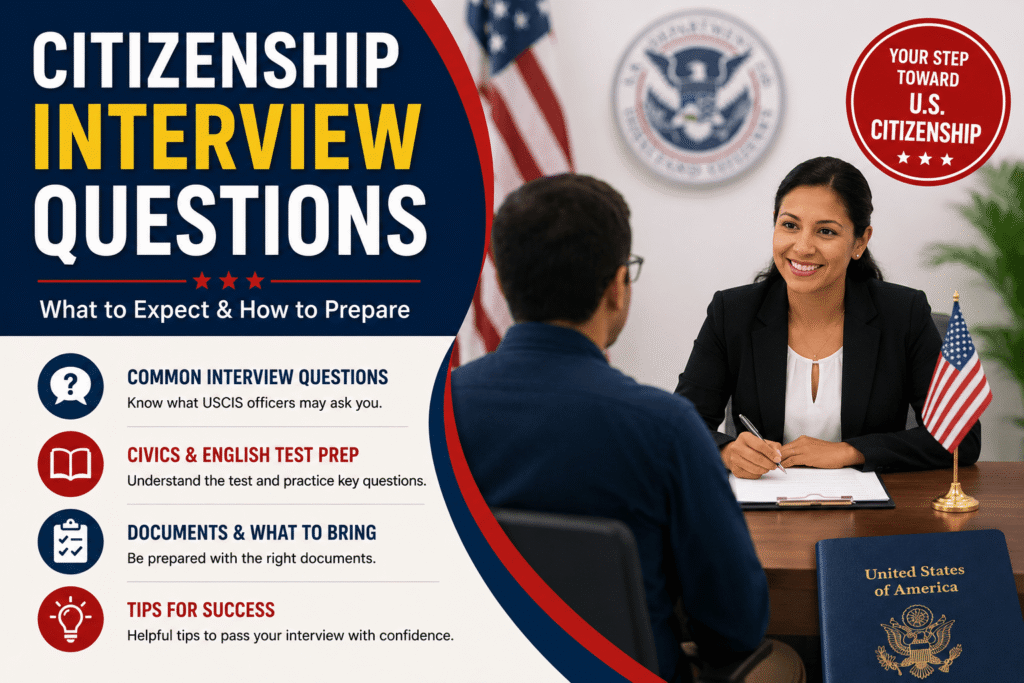
Guide to the US Citizenship Interview Questions
It is the citizenship interview that feels like the big moment for many green card holders. You have filled out your application, you have submitted other documents and gone through biometrics, and now you are sitting in front of a USCIS officer who will make the decision of whether or not to allow you to proceed toward becoming a U.S. citizen.
The good news? The majority of applicants who study for this test do well.
So, if you’re looking to know what citizenship interview questions they will ask you/how the interview works and mistakes to avoid during this time this guide below will help prepare you so that when your appointment comes around you’ll feel ready.
7 Questions Which Are Asked During The Citizenship Interview?
Once you pass the citizenship interview and your oath ceremony, it is time to prepare for naturalization, which is an aspect of U.S. Citizenship and Immigration Services (USCIS).
The officer’s job is to:
- Verify your identity
- Review your Form N-400
- Test your English skills
- Administer the civics test
- Confirm your eligibility for citizenship
Most applicants have imagined a tough interview. Actually, the majority of interviews are closer to an in-depth discussion about your application.
How Much Time Does the Interview Take?
Length of Interviews for Citizenship Most citizenship interviews are between 20 and 45 minutes long.
Those values have an average length but it greatly depends on:
- Your immigration history
- Travel history
- Family situation
- Any issues requiring clarification
Bringing Documents to Your Interview
Before we go over citizenship interview questions, be sure you have the right documents.
Typically, USCIS requests:
- Green Card
- Passport
- State-issued ID
- Interview appointment notice
- Tax returns (if requested)
- Marriage certificates (if applicable)
- Divorce records (if applicable)
- Selective Service records (if required)
Not having one document could cause some delay.
[INTERNAL LINK: Form N-400 Instructions]
Section 10: Your N-400 Application, Part 1 >> Citizenship Interview Questions
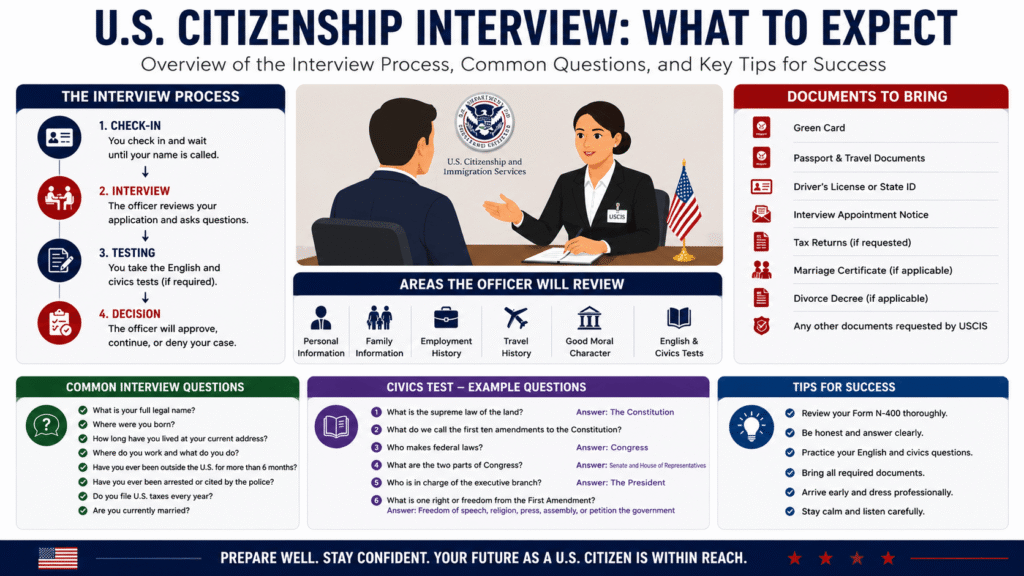
The first portion of the interview is for details you have already provided in your citizenship application.
For example, the officer might pose questions including:
Personal Information Questions
- What is your full legal name?
- When is your birthday?
- Where were you born?
- What is your current address?
- The length of time you have lived at that location?
These questions may appear easy, but are there to validate the information on your application.
Family Questions
You may be asked:
- Are you married?
- What is your spouse’s name?
- When did you get married?
- AP: How many kids you have?
- Where do your children live?
If you applied based on the three-year marriage rule, be prepared for some questions about your spouse as well.
Employment Questions
Common examples include:
- Where do you work?
- What is your job title?
- August 27, 2021 : How Long Have You Worked There?
- Have you changed jobs recently?
The officer just wants to double check the employment history on your application.
Immigration History Questions for the Citizenship Interview
Common Questions Asked In InterviewsTravel history is one of the most obvious topics in interviews
The officer may ask:
- You have been outside of the USA (how many times)
- What is the longest journey you made?
- Why did you travel?
- Did you travel anywhere after submitting your application?
Though, a lot of candidates do not believe in what these characterize least.
My advice? Apply Before the Interview To Revisit Your Travel History
The discussion could even touch on brief excursions.
Questions About Continuous Residence
4- You need to prove the continuity of residence in US.
Questions may include:
- Have you ever lived overseas from the U.S.?
- Have you kept a residence in another country?
- Has U.S. It it expects to complete U before the 2nd or subsequent tax year?
- Did you make a nonresident tax claim?
He just wants to make sure that one of your main homes has always been in the US.
Citizenship Interview Questions on Good Moral Character
A naturalization requirement is showing good moral character.
Applicants usually get anxious about this section.
Don’t panic.
Many of the questions merely verify information that has already been included in the applicant’s Form N-400.
Examples include:
Criminal History Questions
- Have you ever been arrested?
- Ever been cited by police?
- Ever been convicted of a crime?
- Have You Ever Served Time in Jail?
Always answer honestly.
Hiding is usually worse than the problem itself.
Tax Questions
The officer may ask:
- Do you file taxes every year?
- Do you owe taxes?
- Have you not filed a tax return before?
Reviewing tax compliance is a key element of the review process.
Other Character Questions
Examples include:
- If you ever pretended to be a US citizen?
- So from the heading alone, let us get straight on to this one: are you qualified to vote in a U.S.
- Have you not provided enough for your dependants?
These questions are designed to help USICS determine your eligibility.
The English Speaking Portion
Most candidates are clueless that speaking starts the minute a conversation between the interviewer and him/her begins.
The officer assesses also if you can:
- Understand questions
- Communicate answers
- Participate in a basic conversation
The required level is not advanced at all.
You don’t need perfect English.
You just need to show basic literacy and comprehension skills.
Citizenship Interview Reading Test Questions
The reading test is straightforward.
One sentence, read correctly.
Examples might include:
- Who lives in the White House?
- Citizens can vote.
- She lives in Washington, D.
US Citizenship and immigration services give you materials to help you study in advance of your interview.
Citizenship Interview Writing Test Questions
You will also write a dictated sentence by the officer.
Examples include:
- Citizens can vote.
- America has fifty states.
- In the White House, the President lives there.
Basic literacy is the target, not perfect grammar.
Quiz on civics test questions
The civics portion is often that which gives the most thought to applicants.
The officer will ask the applicant about 10 questions (from the official USCIS question bank).
You need to get a minimum of six correct answers.
Common Citizenship Test Questions
What is the land’s highest law?
Answer: The Constitution.
First ten amendments to the Constitution are called which amends?
Answer: The Bill of Rights.
Who makes federal laws?
Answer: Congress.
Which body consist of the two parts of Congress?
Answer:
- Senate
- House of Representatives
Who Runs The Executive Branch?
Answer: The President.
Name one right only for United States citizens.
Answer:
- Vote in a federal election
OR
- Serve on a jury
[INTERNAL LINK: Citizenship Test Questions]
What Most Applicants Get Wrong
Having educated individuals about the citizenship process for years, I see a pattern.
The vast majority of applicants spend hours on a civics test that is irrelevant to their background but little or no time reviewing the application form they submitted.
That’s a mistake.
The more time the officer spends talking about your N-400, the less time they have for civics questions.
Review:
- Addresses
- Employment history
- Travel history
- Family information
before your interview.
That prep is likely more useful than memorizing another 20 civics questions.
Why Would You Skip an Answer?
Don’t guess wildly.
Do not hesitate to embarrass yourself and ask the police officer to repeat or clarify the question.
If you cannot recall a specific date, be honest and say so.
This should be simple, because officers at USCIS already know that applicants might not remember all the details from years past.
Honesty is always the right thing to do.
Five Tips to Help You Prepare for Passing Your Citizenship Interview
Arrive Early
Arrive at least half an hour before your appointment.
Dress Professionally
You do not necessarily need to wear a suit, although you should still make sure that the clothes are clean and professional because someone else’s opinion of your appearance will only create a long lasting effect during negotiations.
Review Your Application
Review the N-400 multiple times before your interview.
Bring Updated Information
If there were any changes that happened after filing, bring documentation.
Stay Calm
The officer is NOT trying to trick you, they are assessing for eligibility.
A calm candidate is always way better than a nervous one.
What Happens After the Interview?
Finally, at the conclusion of the interview, the officer may:
Approve Your Application
You’ll be notified of your oath ceremony.
Continue Your Application
USCIS may request additional evidence.
Schedule a Retest
Should you not pass certain parts of the English or civics test, be given a second chance.
Deny the Application
This mainly happens in the case of failure to meet criteria.
The bulk of qualified applicants make it through the process.
Frequently Asked Questions
List of Citizenship Interview Questions
The majority of the questions revolve around your Form N-400 application, travel history, family information, employment history, and eligibility requirements.
Is the citizenship interview difficult?
Most of the interview is doable with a little prep.
Question 1 of 30 civics questions.
USCIS puts you through 10 civics questions, and you’re required to answer at least six correctly.
Can You Fail the Citizenship Interview?
Question: Yes, but those who like get the necessary preparation usually do well. There is also a second chance for some of the sections of the test with USCIS.
Do I need to memorise the entire content of my N-400?
You can take your time to learn it, don’t memorize this word for word, but review carefully until you can write down each of the answers.
Final Thoughts
Knowing the most common citizenship interview questions can help ease your anxiety tremendously, and boost your confidence on interview day. The majority of interviews consist of just confirming the information you already provided and making sure you meet the naturalization requirements.
Review your Form N-400, prepare for the civics test and gather documents. Some small @steps can go a long way when you finally sit down with a USCIS officer.
The citizenship interview is one of the last steps in your path to U.S. citizenship. Do your homework, stay calm and believe in the work you’ve done to get here.