

100 Civics Questions For The U.S. Citizenship Test
The citizenship test will be one of your last hurdles to full U.S. citizenship. When in reality, this part of the naturalization process seems like a developed fear for many green card holders. The positive thing is that the test is super predictable as USCIS publishes official questions in advance of the test.
That means no surprises.
To help you feel more prepared for your naturalization exam success (and, ultimately, achieving U.S. citizenship), knowing the most critical questions from the citizenship test can help and improve significantly your success in this type of tests. This guide outlines how the test works, what kinds of questions appear most often and how to study with maximum efficiency.
What Is the Citizenship Test?
The citizenship test is involved in the naturalization interview wherein USCIS conducts the interview.
While the interview, a USCIS officer assesses:
- English speaking ability
- Reading ability
- Writing ability
- Literacy in U.S. history and civics
What most people are referring to when talking about the citizenship test questions is the civics portion.
There is an official list of civics questions (100) published by USCIS. Questions Asked with the Interview – In the interview, he or she will ask you up to 10 Questions of your capacity.
To pass, you need at least 6 right.
Good News for Applicants
You are not memorizing arcane legal documents or minutiae of American history.
The issues are of fundamental importance that every citizen should be familiar with.
How the USCIS Civics Test Operates
The officer asks questions verbally.
For example:
Officer:
The supreme law of the land is: “What?”
Applicant:
“The Constitution.”
That’s it.
No essay writing.
No multiple-choice questions.
No trick questions.
It is less an interview and more a dialogue than the test of a classroom.
Citizenship Interview Questions
Citizenship Test Questions 1
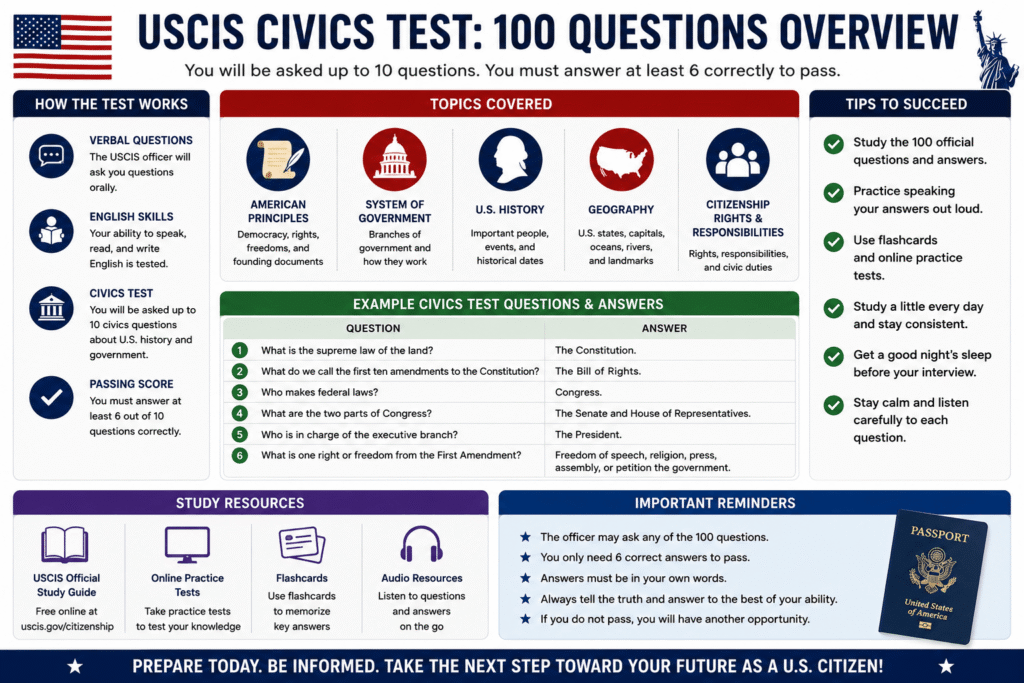
Although USCIS has the discretion to pose any of the 100, official questions, some topics come up more frequently than others.
Lets recap the more significant points.
1 What Is the Supreme Law of the Land?
Answer:
The Constitution
This question shows up all the time because the US government is based on the Constitution.
2. What do you call the first ten amendments to the Constitution?
Answer:
The Bill of Rights
Amendments protecting freedoms of speech, religion, and assembly.
3. Who Makes Federal Laws?
Answer:
Congress
The way to remember this, for many applicants, is as follows:
Congress creates laws.
The President signs laws.
The Supreme Court interprets laws.
4. What are these Two Chambers of Congress?
Answer:
- Senate
- House of Representatives
You can provide either order.
5. How Many Senators Are in the U.S.?
Answer:
100
Every state has two senators.
50 states × 2 senators = 100.
6. So instead, what is the membership of the House of Representatives in terms of voting members?
Answer:
435
This figure frequently appears on the citizenship examination.
7. Which Branch of Government is in Charge of the Executive?
Answer:
The President
The executive branch enforces federal laws.
8. What Does the Cabinet of the President Consist Of?
Answer:
Advises the President
Consider the Cabinet as the President’s top advisers team.
9. Two rights under the Declaration of Independence 3.
Possible Answers:
- Life
- Liberty
- Pursuit of Happiness
Any two are acceptable.
10. What Is Freedom of Religion?
Answer:
You have the right to practice any religion or no religion.
This question represents one of the most fundamental freedoms in America.
Citizenship Test Group Questions on American History
There are many names and dates, so applicants worry that history questions are unit dimensional;
The good news is you need little more than a high-level understanding of how it works.
Which Former President Was First?
Answer:
George Washington
This is one of the simplest questions which is asked very often.
Who Freed the Slaves?
Answer:
Abraham Lincoln
Lincoln ranks as one of the most important figures in American history.
What War Did the US Fight in the Early 1900s?
Possible Answers:
- World War I
- World War II
- Korean War
- Vietnam War
- Gulf War
Any correct answer works.
Q: What event happened on September 11, 2001?
Answer:
Terrorists attacked the United States.
During the preparations, many applicants see this question.
1 — Name an American Indian Tribe in the United States
Possible Answers:
- Cherokee
- Navajo
- Apache
- Sioux
- Choctaw
USCIS accepts several correct answers.
Citizenship Test Questions About Geography
Some questions are related to geography and national symbols.
The United States is all about providing freedom, and in the context of asking what is the capital of the United States, it seems irrelevant.
Answer:
Washington, D.C.
Which Ocean Is Located on the East Coast?
Answer:
Atlantic Ocean
Now the final question: What ocean is on the West Coast?
Answer:
Pacific Ocean
Geography, Name a state that can be found bordering Canada.
Examples:
- Alaska
- Washington
- Montana
- Minnesota
- New York
Several answers are acceptable.
Name One State Which Borders Mexico.
Examples:
- California
- Arizona
- New Mexico
- Texas
Again, every valid state will work.
Government Questions from the Citizenship Test
This is a broad topic testing category for government structure.
Q: How does one branch of government not become more powerful than another?
Answer:
Checks and balances
Who Vetoes Bills?
Answer:
The President
What is the function of the judicial branch?
Answer:
- Reviews laws
- Explains laws
- Resolves disputes
Any correct response is accepted.
How Many Justices Are There on the Supreme Court?
Answer:
Nine
Well, what is the Court at the Highest in America?
Answer:
The Supreme Court
Questions of Citizens Rights and Duties
USCIS is eager for applicants to comprehend the notion of citizenship.
One Right Only for U.S. Citizens
Possible Answers:
Vote in a federal election
Run for federal office
Only for U.S. Citizens What Is One Responsibility?
Answer:
Serve on a jury
Vote in a federal election
When do Men have to Register for Selective Service?
Answer:
At age 18
Most male applicants will be asked about their Selective Service registration.
Study the Citizenship Test Questions effectively
Almost the moin thingMost applicants keep drawing their moin than it shouldbe.
Focus on Understanding
If you still think this to build vocabulary skimming just any word means memorizing words, cleave vagueness.
For example:
Don’t memorize:
“Congress”
Instead understand:
The function of Congress is to legislate, or make laws.
Understanding improves recall.
Study in Short Sessions
Researchers have long been aware that shorter study sessions lead to better memory.
Try:
- 20 minutes daily
- Flashcards
- Practice quizzes
- Audio recordings
Moment, micro learning is better for memory retention than a marathon.
Practice Out Loud
Note: The civics test is oral.
Practice answering aloud.
The answer to many of the interview question is not new to most applicants. We all know it, but people struggle because they have never had to express it verbally before.
Common Mistakes Applicants Make
Learning Too Much at Once
There are 100 questions in the official list.
Study gradually.
Ignoring Current Government Officials
Some question rests on people in currently held offices.
Always review the most recent set of USCIS study materials before your interview.
Focusing Only on Civics
Remember:
Your interview also includes:
- English speaking
- Reading
- Writing
- N-400 review
Some applicants prepare for weeks in civics but fail to review their application.
[INTERNAL LINK: Form N-400 Instructions]
What if you can not Pass the Citizenship Test?
Don’t panic.
If you do not pass the civics or English section, USCIS usually allows one re-examination.
You will also be retested on any material you did not pass.
Many applicants fail the exam at their second attempt.
Exemptions from the Citizenship Test
Other applicants may be considered for exceptions.
Examples include:
Age 50/20 Rule
Applicants who:
- Are 50 years old or older
- With a green card for at least 20 years
may qualify for modified requirements.
Age 55/15 Rule
Applicants who:
Are 55 years old or older
Maintained the green card for at least 15 years
may also qualify for accommodations.
Review the USCIS Guidance for your specific situation.
The Most Important Thing Most Applicants Do Not Realize
Here’s something interesting.
The civics test, at least in my experience as an immigration attorney, is something that really people are more scared of than they need to be.
The reality is that USCIS gets you a copy of every question beforehand.
However, for most applicants the real challenge is to review their Form N-400 and prepare possible interview questions in regard of travel history, employment relation and family information.
It is through studying that the civics test often ends up being the easiest part of the interview.
Frequently Asked Questions
Other than that, how many citizenship test questions exist between answers?
USCIS Posts 100 Civics Questions for Applicants to Study for Naturalization.
Both questions: If you could ask anything during the interview, how many questions could be Rs.
Such questions will be asked by the officer not more than ten.
How many answers do I need to get right?
Answer at least 6 questions correctly
Citizenship test is multiple choice?
Nah, goes something like: a question is asked verbally, you answer also verbally.
What if I don’t pass the civics test?
Uscis will typically schedule you for a second chance to take only the portion you failed.
Final Thoughts
Studying for citizenship test questions doesn’t have to be scary. It’s all public knowledge: the questions, format; hundreds of thousands of applicants complete it every year.
Study early, answer the questions in front of a mirror and remember to understand it and not just memorise it. When you combined it with an in depth review of your citizenship application and interview preparation, you place yourself in a prime position for success.
You study for every question and you move closer to be a U.S. citizen.